
Aspen HYSYS Reactor Modeling: Kinetic and Equilibrium Reactors for Chemical Process Design
Chemical process engineers routinely face the challenge of accurately modeling reactor behavior—whether for greenfield plant design, debottlenecking, or safety analysis. Aspen HYSYS, one of the most widely deployed process simulators in the oil, gas, and petrochemical industries, provides a comprehensive suite of reactor models that span from simple equilibrium assumptions to rigorous kinetic formulations. This article examines the key reactor types available in HYSYS, best practices for kinetic data entry, and how to leverage sensitivity analysis to optimize reactor performance.
Overview of HYSYS Reactor Models
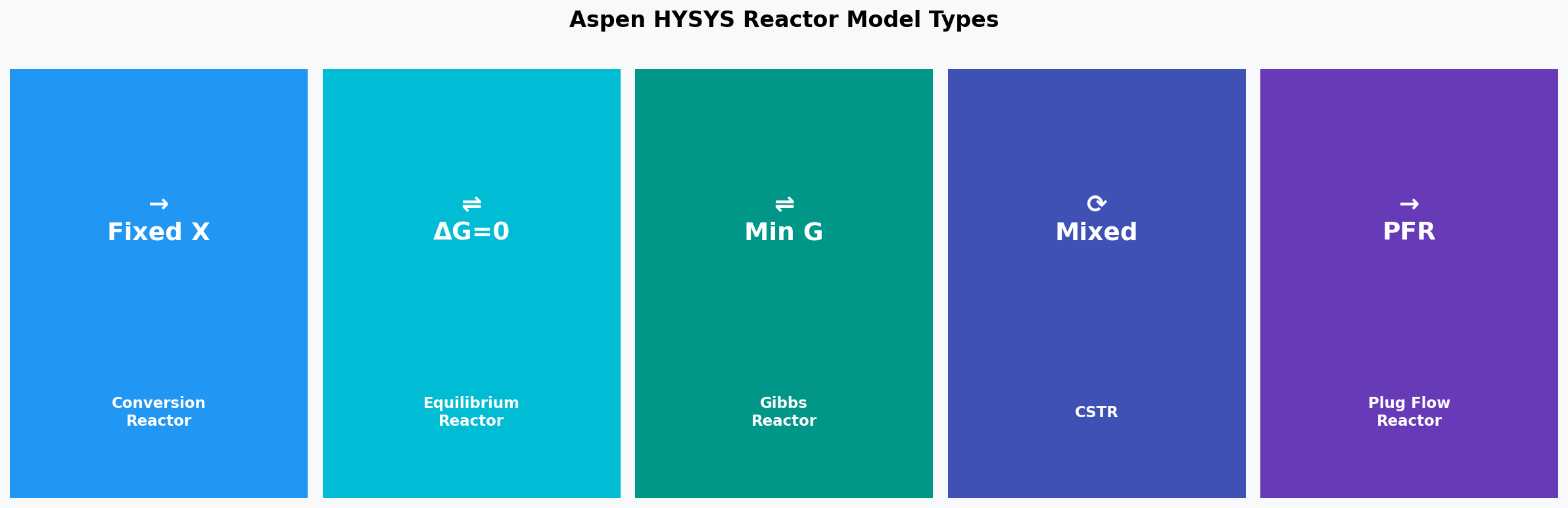
Aspen HYSYS offers five primary reactor operation units, each suited to different levels of modeling fidelity:
- Conversion Reactor – Specifies fractional conversion of a key component. Ideal for preliminary design when kinetic data are unavailable.
- Equilibrium Reactor – Calculates outlet composition by minimizing Gibbs free energy or by specifying equilibrium constants. Suitable for fast, reversible reactions such as steam reforming or ammonia synthesis.
- Gibbs Reactor – A special case of the equilibrium reactor that minimizes total Gibbs free energy across all specified components without requiring stoichiometry input.
- CSTR (Continuous Stirred Tank Reactor) – Models a perfectly mixed vessel with user-defined kinetic expressions. Supports power-law and Langmuir-Hinshelwood-Hougen-Watson (LHHW) rate forms.
- Plug Flow Reactor (PFR) – Integrates kinetic rate equations along the reactor length, assuming no radial mixing. Essential for tubular reformers, fixed-bed catalytic reactors, and polymerization trains.

Entering Kinetic Rate Expressions
Accurate kinetic modeling in HYSYS begins with the Reactions Manager, accessible from the Simulation menu. Engineers define reaction sets that are then attached to CSTR or PFR operations.
Power-Law Kinetics
For a reaction of the form A + B → C, the power-law rate expression is:
r = k₀ · exp(−Eₐ / RT) · [A]^m · [B]^nIn HYSYS, you enter:
- Pre-exponential factor (k₀) and activation energy (Eₐ) in the Kinetics tab.
- Concentration basis: molar concentration, partial pressure, or fugacity.
- Reaction phase: vapor, liquid, or combined.
A common pitfall is mismatching the concentration basis between the kinetic expression and the fluid package. If the thermodynamic package reports fugacity-based activities (e.g., Peng-Robinson), ensure the rate expression uses the same basis to avoid systematic errors in conversion predictions.
LHHW Kinetics
Heterogeneous catalytic reactions—such as hydrodesulfurization (HDS) or Fischer-Tropsch synthesis—often require LHHW expressions that account for adsorption equilibria on the catalyst surface. HYSYS supports the general LHHW form:
r = (kinetic term) / (adsorption term)^nEach term is entered as a product of Arrhenius-type expressions for individual species. This level of detail is critical when modeling inhibition effects, such as H₂S suppression of HDS activity.
Connecting Reactors to Thermodynamic Packages
The choice of fluid package profoundly affects reactor simulation accuracy. For hydrocarbon systems, Peng-Robinson or Soave-Redlich-Kwong equations of state are standard. For aqueous electrolyte systems (e.g., amine treating, sour water stripping), the Acid Gas or Amine fluid packages incorporate activity coefficient models that correctly handle vapor-liquid-liquid equilibria.
Best practice: always run a flash sensitivity on the reactor feed stream before attaching kinetics. Verify that the predicted phase envelope and component fugacities match experimental data or literature values. Errors in thermodynamics propagate directly into kinetic rate calculations.
Sensitivity Analysis and Optimization
Once a reactor model converges, HYSYS's built-in Databook and Case Studies tools enable systematic sensitivity analysis:
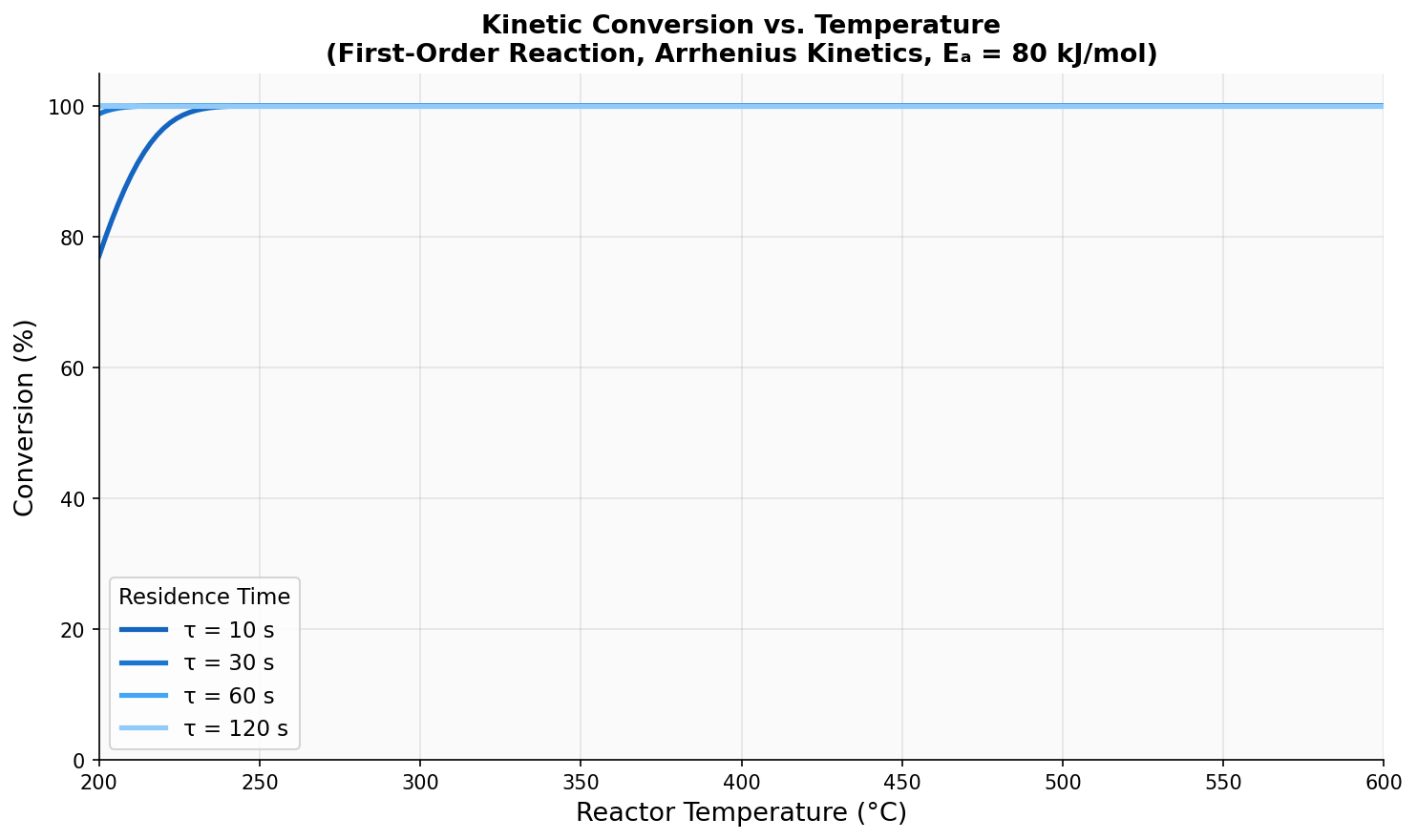
- Temperature sensitivity – Vary reactor temperature over a defined range and track conversion, selectivity, and heat duty. This identifies the optimal operating window balancing conversion against undesired side reactions.
- Residence time / volume sensitivity – For PFRs, sweep reactor length or volume to generate conversion-vs-volume profiles, directly informing vessel sizing.
- Feed ratio sensitivity – Adjust reactant stoichiometry to maximize yield of the desired product while minimizing raw material cost.
For formal optimization, HYSYS integrates with Aspen Optimization (formerly DMO), which applies SQP (Sequential Quadratic Programming) algorithms to minimize cost functions subject to process constraints such as maximum temperature, pressure drop limits, and product purity specifications.
Heat Integration in Reactor Loops
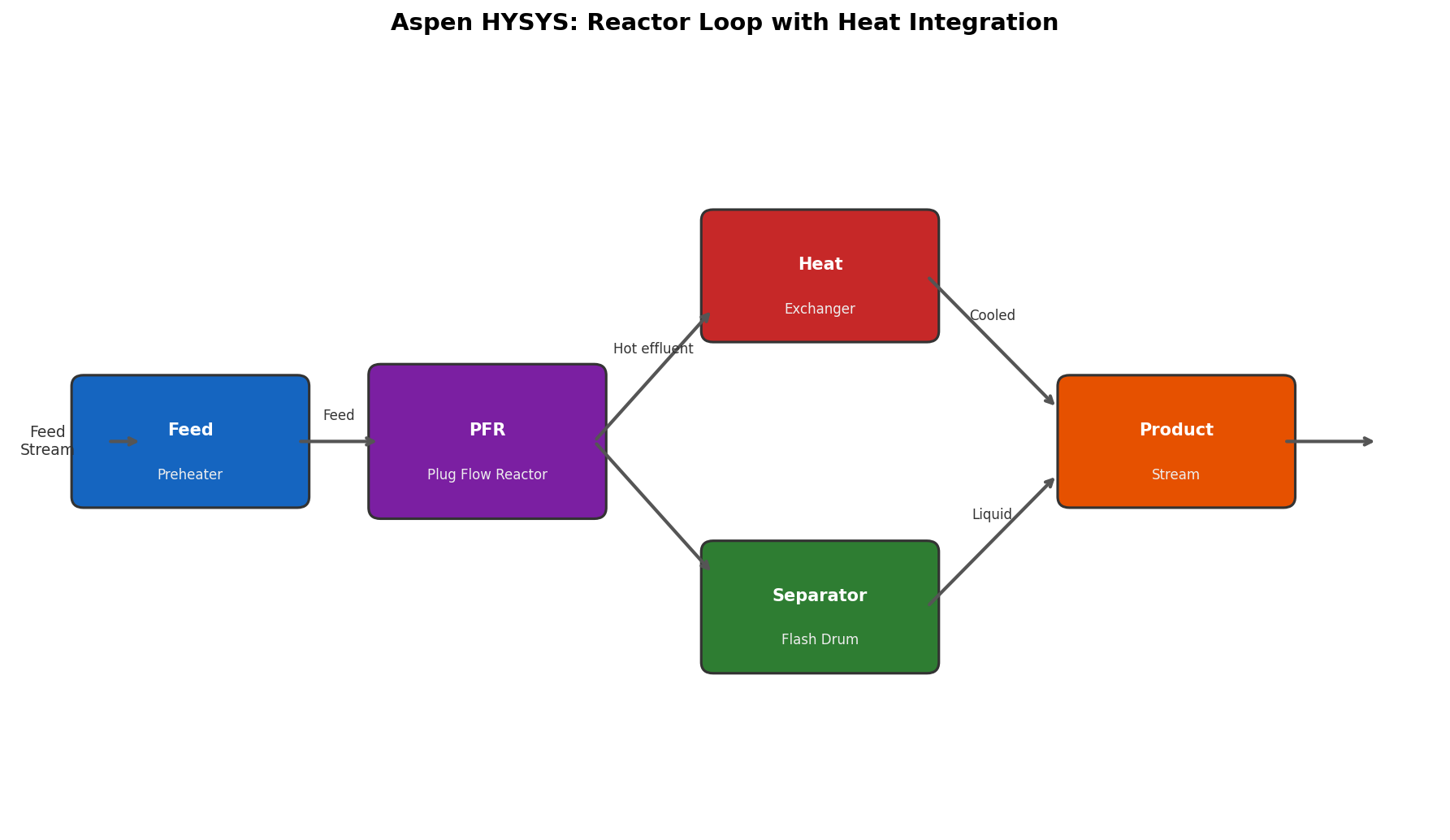
Exothermic reactors—such as methanol synthesis or ethylene oxide production—generate significant heat that must be managed carefully. HYSYS supports cooled PFR configurations where a coolant stream runs counter-currently or co-currently alongside the reaction zone. The heat transfer coefficient (U) and tube geometry are specified directly in the PFR operation, enabling simultaneous solution of the energy and material balances.
For complex reactor-heat exchanger networks, coupling the HYSYS reactor model with the Exchanger Design & Rating (EDR) module provides rigorous shell-and-tube or plate-fin heat exchanger calculations, ensuring that the thermal design is consistent with the process simulation.
Practical Tips for Convergence
- Initialize with a Conversion Reactor before switching to a kinetic model. This provides a good initial estimate of outlet composition, reducing convergence iterations.
- Tighten tolerances gradually – Start with loose convergence tolerances (1×10⁻³) and tighten to 1×10⁻⁶ once the model is stable.
- Check the Jacobian – For stiff kinetic systems (large differences in reaction rate constants), enable the stiff ODE solver in the PFR settings.
- Use component lists – Limit the active component list to species relevant to the reaction system. Unnecessary components increase computational load and can introduce spurious phase splits.
Conclusion
Aspen HYSYS provides a robust, industry-proven environment for reactor modeling across the full spectrum of chemical and petrochemical processes. By selecting the appropriate reactor type, carefully entering kinetic parameters with consistent thermodynamic bases, and leveraging sensitivity and optimization tools, engineers can develop high-fidelity models that support both design decisions and operational troubleshooting. As digital twin adoption accelerates across the process industries, mastery of HYSYS reactor modeling remains a core competency for chemical process engineers.