

NetLogo: Agent-Based Modeling for Social Sciences and Complex Systems
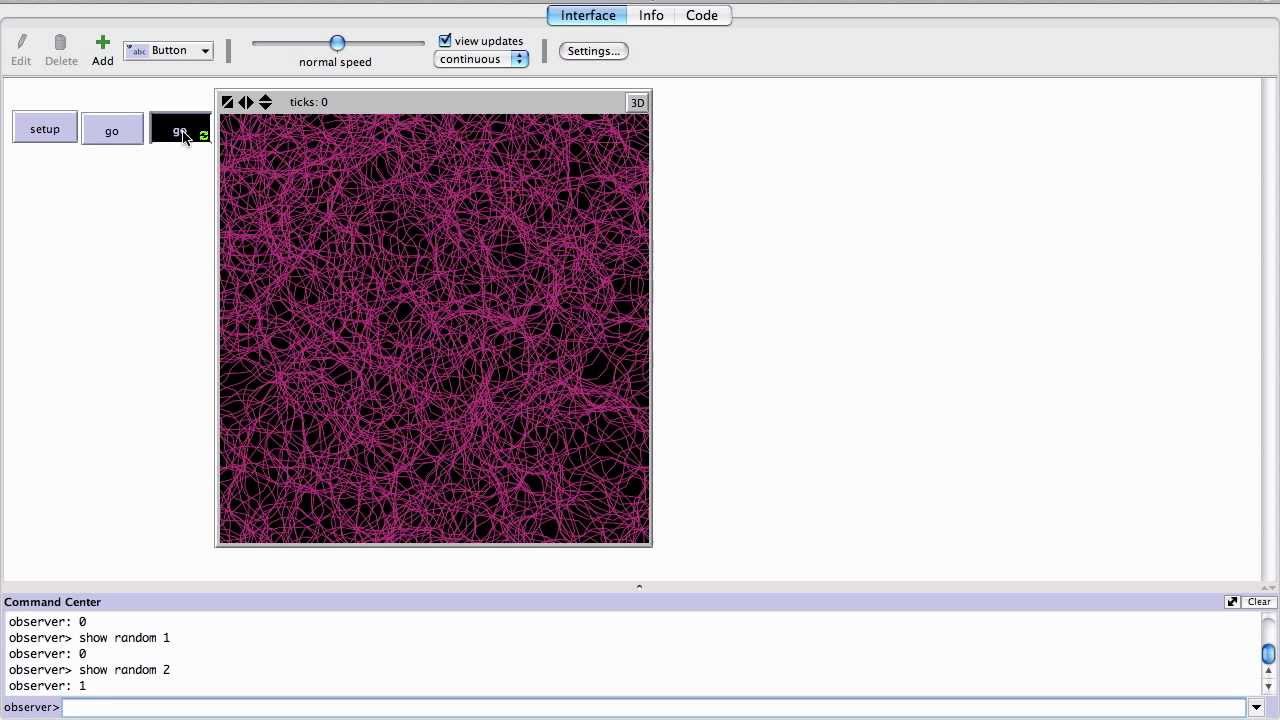
NetLogo stands as a preeminent platform for Agent-Based Modeling (ABM), offering a robust yet accessible environment for simulating complex systems across diverse fields. Developed at Northwestern University, NetLogo democratizes the process of building and analyzing intricate real-world phenomena by allowing researchers and developers to model individual autonomous agents and their interactions.
Understanding Agent-Based Modeling (ABM)
Agent-Based Modeling represents a paradigm shift in understanding complex systems, moving away from traditional top-down equations that describe system-wide behavior. Instead, ABM simulates individual agents and their interactions, allowing for the emergence of complex system-wide patterns from simple individual rules.
Core Concepts of ABM
1. Individual Agents
At its core, ABM treats each system component as an independent agent. These agents can represent a wide array of entities, such as predators in an ecosystem, traders in a market, voters in an election, people, vehicles, organizations, or biological cells. Each agent operates according to its own programmed behavioral rules.

2. Autonomous Behavior
A crucial concept in ABM is the autonomous behavior of agents. Unlike traditional models where behavior is dictated by rigid equations, agents in ABM make independent decisions based on their current state, goals, and interactions with their environment. This autonomy allows the model to capture realistic and nuanced behaviors in complex systems.
3. Interactions
The interactions between agents are fundamental to ABM. These interactions can be direct, such as communication between two people, or indirect, like how traders affect market prices. Through these interactions, simple individual behaviors can lead to complex system-wide patterns, such as the spread of innovation through a social network or the formation of traffic patterns.
4. Emergent Properties
The power of ABM lies in its ability to reveal emergent properties. These are system-wide patterns and behaviors that are not explicitly programmed into individual agents but arise from their collective interactions. For instance, traffic jams can emerge from simple interactions between individual drivers, even when no single driver intends to cause congestion.
ABM excels at capturing non-linear, surprising behaviors that characterize real-world complex systems, accommodating situations where small changes have large effects or where the same starting conditions lead to different outcomes.
NetLogo: A Powerful Platform for ABM
NetLogo is a widely used programming language and integrated development environment (IDE) specifically designed for building agent-based simulations. It provides a user-friendly interface and a comprehensive approach to building and analyzing complex systems.
Installation and Setup
Getting started with NetLogo is straightforward. The platform is cross-platform, available for Windows (7 and later), Mac OS X (10.8.3 or newer), and Linux (standard Debian-based and Red Hat-based distributions). Each version comes bundled with its own Java 8 runtime, which helps eliminate common compatibility issues.
Users can download the appropriate version and either run the installer (Windows/Mac) or extract the files (Linux) to create the NetLogo directory. This directory contains executables for both standard NetLogo and NetLogo 3D, along with comprehensive documentation.
For those unable to install the desktop application, such as Chromebook users, NetLogo offers a web-based alternative at NetLogoweb.org, ensuring accessibility across various devices.
Navigating the Interface
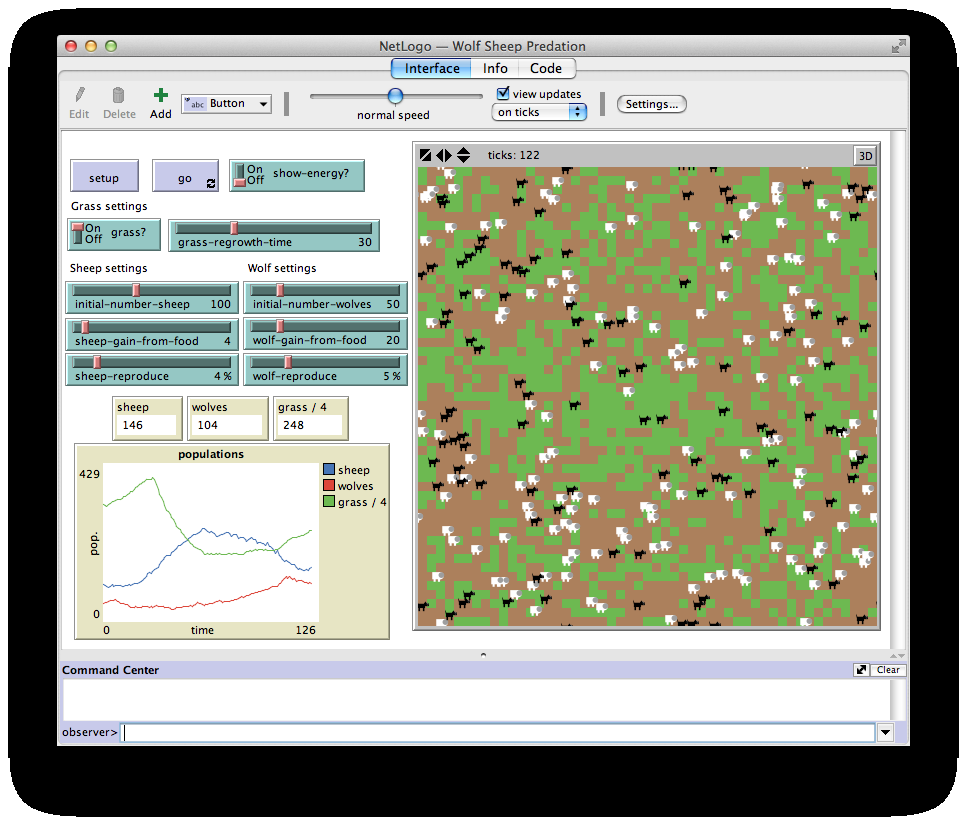
The NetLogo interface is thoughtfully organized into two main components: the menu system and the main window, which features three essential tabs:
- Interface Tab: This serves as the primary workspace where users interact with models and visualize data. It acts as the model's control center, allowing real-time adjustment of parameters and observation of results.
- Info Tab: This tab provides documentation and context for the models, explaining their purpose, mechanics, and suggested modifications.
- Code Tab: This tab houses the programming logic, maintaining a clean separation between model behavior and presentation.
Core Components and Programming Elements
NetLogo provides four built-in types of agents, which form the fundamental building blocks of any simulation:
- Observer: This agent "observes" the simulation and is located outside the scope of the other elements. It acts as the global context, executing commands that affect the entire system or report global properties.
- Patches: These are stationary agents that form the grid-based environment of the simulation. They represent the "world" or "terrain" on which other agents move and interact. For example, in the Forest Fire model, patches might represent trees or burnt ground.
- Turtles: These are mobile agents that move around the patches and interact with each other and their environment. They represent the active entities in the simulation, such as wolves, sheep, people, or vehicles.
- Links: These agents connect turtles, representing relationships or connections between them, such as social ties in a network.
NetLogo's basic code elements include procedures, primitives, commands, and reporters. A typical NetLogo program is organized around setup and go procedures. The setup procedure initializes the model, creating agents and setting initial conditions, while the go procedure runs the simulation iteratively, often advancing by "ticks," which can be an arbitrary unit of time.
Exploring Pre-built Models
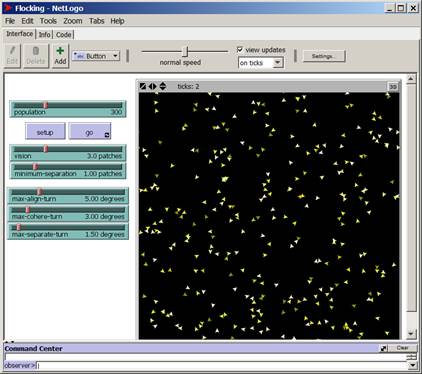
One of NetLogo's greatest strengths is its extensive Models Library, accessible through the File menu. These pre-built simulations serve as excellent learning tools and starting points for new projects. Examples include the Wolf Sheep Predation model, which introduces population dynamics, and the Forest Fire model, demonstrating how simple rules can create complex emergent behaviors.
Each model comes with detailed documentation, allowing users to learn by example and gradually build their understanding of NetLogo's capabilities. Experimenting with different parameters in these models and observing their effects provides invaluable hands-on experience.
Advanced Features of NetLogo
NetLogo's capabilities extend far beyond basic modeling, offering a sophisticated toolkit for advanced users and researchers.
BehaviorSpace
At the heart of NetLogo's advanced features is BehaviorSpace, a powerful integrated tool that revolutionizes how researchers conduct simulation experiments. BehaviorSpace enables the systematic exploration of model behavior by automatically running multiple simulations while varying parameters.
This experimental approach, often called "parameter sweeping," allows researchers to discover optimal configurations and understand complex system dynamics. Instead of manually testing thousands of possible combinations, BehaviorSpace efficiently maps the entire parameter space of a model, recording results for each variation.
For instance, when studying population dynamics with variables like population size, reproduction rates, and environmental factors, BehaviorSpace can automatically run simulations across all parameter combinations, saving countless hours of manual experimentation. The tool's parallel processing capabilities further accelerate this process by utilizing multiple processor cores simultaneously.
Extension System and Integration Capabilities
NetLogo's extension system opens up entirely new modeling possibilities. These specialized add-ons enhance the platform's core functionality, enabling everything from advanced statistical analysis to integration with external data sources. Through these extensions, modelers can incorporate GIS data, connect to databases, or implement sophisticated algorithms without leaving the NetLogo environment.
The platform's integration capabilities are particularly noteworthy. NetLogo models can interact with external systems through various mechanisms, making it possible to process real-time data or export results to other analytical tools. For example, NetLogo can be linked to Mathematica and R, allowing users to leverage the analytical capabilities of these powerful statistical and computational environments for analyzing NetLogo model results.
The RNetLogo package facilitates this connection. Users can even call R functions from within their NetLogo model, for instance, to generate random deviates from distributions not included in NetLogo's primitives. However, calling R from within NetLogo carries a speed cost, requiring a trade-off between model execution speed and model development time.
Logging, Monitoring, and 3D Capabilities
Advanced logging and monitoring features provide detailed insights into model behavior. Researchers can track specific metrics over time, export data in various formats, and generate comprehensive reports of simulation results. This systematic approach to data collection and analysis ensures that complex simulations yield actionable insights.
NetLogo also supports 3D capabilities, allowing for more immersive and spatially explicit visualizations. This is particularly valuable for models that require three-dimensional spatial representation.
Community Support
NetLogo benefits from a strong and supportive community. Resources include a comprehensive Help Page, Google Group, Stack Overflow, mailing lists, tutorials, and extensive documentation. This community actively fields questions from beginners, contributing to NetLogo's reputation as an approachable platform.
Applications in Social Sciences and Beyond
ABM, particularly with NetLogo, has revolutionized computational modeling across a multitude of disciplines, providing a powerful tool to recreate and study intricate real-world phenomena. It is widely used for modeling complex systems and spatially-explicit behavior or processes.
Social Sciences
ABM has become an invaluable tool for understanding complex social phenomena, offering insights into how individual behaviors shape collective outcomes.
Population Dynamics: Researchers use ABM to capture the interplay between individual decisions and demographic shifts, revealing how choices about migration, family formation, and resource allocation influence broader societal patterns. This provides valuable insights for urban planning and policy development.
Market Behavior: By modeling individual economic actors (consumers, corporations), researchers can observe how micro-level decisions affect the economic system. These models are valuable for understanding market volatility, consumer trends, and economic patterns that traditional methods often struggle to explain.
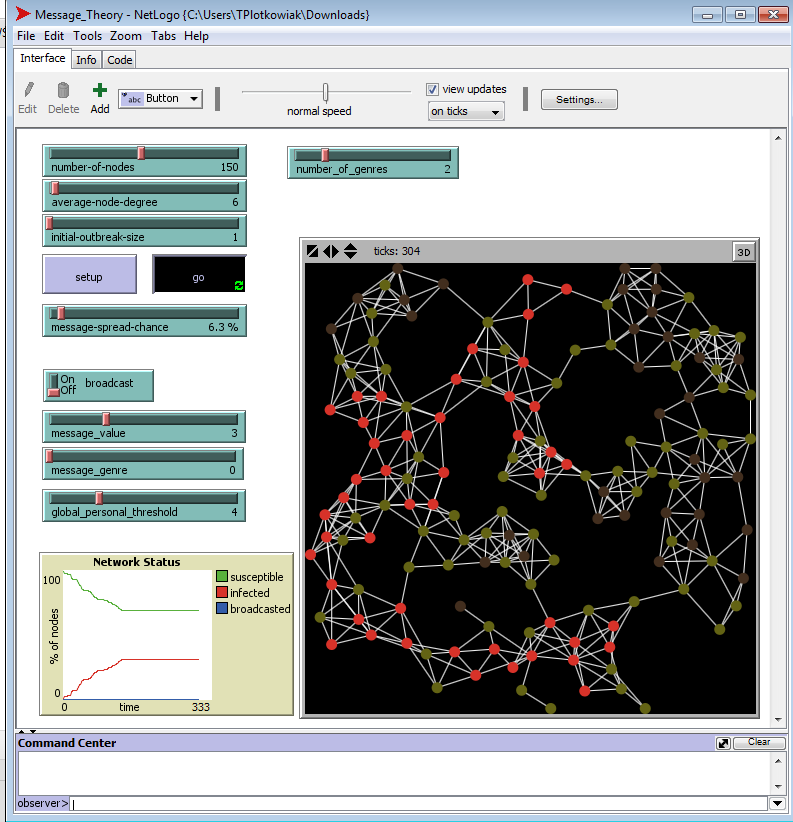
Social Networks: ABM enhances our understanding of social networks by modeling individual interactions, mapping how information spreads, opinions form, and communities evolve. These insights have practical applications in public health interventions and social media platform design, helping to understand how individual connections contribute to larger social movements and cultural shifts.
Policy Evaluation: During the global pandemic, agent-based models helped policymakers understand how individual behavior affects disease spread and evaluate the impact of various intervention strategies, demonstrating ABM's ability to bridge academic research and practical policy-making.
Ambient Intelligence (AmI) Scenarios: NetLogo has been used to develop agent-based simulations to evaluate AmI scenarios. For example, a simulation was developed to analyze the benefits of an AmI scenario in airports, measuring agent satisfaction of desires and time savings obtained through correct use of context information. This model considered scalability problems and used FIPA and BDI extensions, simulating user agents passing through various zones like passport controls, check-in counters, boarding gates, and shopping areas.
Natural and Engineered Systems
Beyond social sciences, NetLogo is widely applied to natural and engineered complex systems:
Ecosystems: Simulating predator-prey relationships, population dynamics, and resource allocation in ecological systems.
Traffic Flow: Modeling individual drivers and their interactions to understand traffic jams and optimize traffic flow.
Disease Spread: Simulating the spread of diseases based on individual contact patterns and behaviors.
Animal Movement: NetLogo has been used to build models of animal movement, with simulation experiments run on supercomputers to overcome computational limitations.
Educational Applications
NetLogo serves as an excellent educational tool for teaching complex systems concepts:
Interactive Learning: Students can manipulate model parameters and immediately see the effects, providing intuitive understanding of complex phenomena.
Interdisciplinary Applications: The platform is used across disciplines, from biology and ecology to economics and sociology.
Research Training: Graduate students and researchers use NetLogo to develop and test theoretical models in their respective fields.
Best Practices in Agent-Based Modeling with NetLogo
Building effective agent-based models requires careful attention to model credibility and validation. As NASA emphasizes, "accuracy builds credibility" in complex simulations.
Challenges in ABM Development
1. Model Accuracy vs. Computational Complexity
Ensuring model accuracy while balancing computational complexity is a significant challenge, especially when modeling large-scale systems with thousands of interacting agents.
2. Verification and Validation (V&V)
- Verification: Confirms that the model implementation matches the intended design
- Validation: Ensures the model accurately represents the target system
Both processes require systematic testing and careful documentation. Effective validation often involves comparing model outputs against empirical data and conducting sensitivity analyses.
3. Bias Mitigation
Modelers must carefully examine their assumptions and parameter choices to avoid introducing unintended biases, including technical biases in model structure and cognitive biases in agent decision-making representation.
Best Practices for Model Development
To address these challenges, several best practices have emerged from the ABM community:
-
Rigorous Verification and Validation Plan: Implement a clear V&V plan early in the development process, including documentation of testing procedures, validation criteria, and methods for assessing model accuracy.
-
Systematic Model Testing: Conduct unit testing of individual agent behaviors, integration testing of agent interactions, and comprehensive validation against real-world data when available. Regular testing helps identify issues early.
-
Thorough Model Documentation: Document model assumptions, limitations, and validation results. This significantly improves model credibility and reusability.
-
Iterative Refinement: Start with a simple baseline model and systematically add complexity, validating each iteration. This approach maintains model tractability while ensuring each addition genuinely improves model utility.
-
Clear Model Objectives and Validation Criteria: Define specific metrics for assessing model performance and accuracy before starting development to provide concrete targets for V&V efforts.
-
Version Control: Maintain careful version control of both model code and documentation throughout development to create a clear record of model evolution and validation results.
-
Independent Verification and Validation: When possible, consider having external experts review the model to identify potential issues and biases that internal teams might miss, thereby improving model credibility and reliability.
Advanced Applications and Case Studies
Complex Adaptive Systems
NetLogo excels at modeling complex adaptive systems where agents adapt their behavior based on experience and environmental feedback. Examples include:
Economic Markets: Modeling how traders adapt their strategies based on market performance and information.
Organizational Behavior: Simulating how organizations evolve and adapt to changing environments.
Cultural Evolution: Modeling how cultural practices spread and evolve through populations.
Multi-Scale Modeling
NetLogo can be used to model phenomena that occur at multiple scales:
Urban Dynamics: Modeling individual behavior that aggregates to neighborhood and city-level patterns.
Ecosystem Management: Simulating individual organism behavior that affects population and ecosystem dynamics.
Technology Adoption: Modeling how individual adoption decisions lead to market-level technology diffusion.
Policy and Intervention Testing
ABM with NetLogo provides a powerful platform for testing policy interventions:
Public Health: Testing the effectiveness of different intervention strategies for disease control.
Environmental Policy: Evaluating the impact of conservation policies on ecosystem dynamics.
Social Policy: Assessing the effects of social programs on community outcomes.
Future Directions and Innovations
Integration with Big Data
NetLogo is increasingly being integrated with big data sources to create more realistic and data-driven models:
Real-time Data Integration: Connecting models to live data feeds for dynamic simulation.
Machine Learning Integration: Using ML algorithms to calibrate agent behaviors based on empirical data.
Social Media Data: Incorporating social media data to understand information spread and opinion dynamics.
Advanced Visualization and Analysis
New developments in visualization and analysis tools are enhancing NetLogo's capabilities:
Virtual and Augmented Reality: Creating immersive environments for model exploration.
Advanced Analytics: Integrating sophisticated statistical and machine learning tools for model analysis.
Interactive Dashboards: Developing web-based interfaces for model interaction and exploration.
Collaborative Modeling
NetLogo is evolving to support more collaborative modeling approaches:
Cloud-based Modeling: Enabling collaborative model development through cloud platforms.
Participatory Modeling: Involving stakeholders in the model development process.
Cross-platform Integration: Connecting NetLogo models with other simulation platforms and tools.
Conclusion and Future Directions
NetLogo, with its intuitive interface, robust features, and strong community support, has firmly established itself as a leading platform for agent-based modeling. It empowers researchers and developers to simulate complex systems, from ecological dynamics to intricate social phenomena, by focusing on the interactions of individual autonomous agents.
The ability to reveal emergent properties, coupled with advanced tools like BehaviorSpace for systematic parameter exploration and extensive integration capabilities with other analytical software, makes NetLogo an indispensable tool for modern computational research.
As computing power continues to increase and modeling techniques become more sophisticated, the applications of ABM with NetLogo are poised for further expansion. Addressing current implementation challenges through rigorous best practices in verification, validation, and documentation will pave the way for even more accurate and applicable ABM across various domains.
The platform's continued development, integration with emerging technologies like machine learning and big data analytics, and growing community of users ensure that NetLogo will remain at the forefront of agent-based modeling. Its ability to make complex systems modeling accessible to researchers across disciplines, combined with its powerful analytical capabilities, positions it as a cornerstone technology for understanding and predicting the behavior of complex systems in our increasingly interconnected world.
NetLogo's emphasis on education and accessibility has democratized agent-based modeling, enabling researchers from diverse backgrounds to explore complex phenomena and contribute to our understanding of emergent systems. As we face increasingly complex global challenges, tools like NetLogo provide essential capabilities for modeling, understanding, and addressing these challenges through evidence-based approaches.
References
- NetLogo Official Website (https://ccl.northwestern.edu/netlogo/)
- NetLogo User Manual (https://ccl.northwestern.edu/netlogo/docs/)
- NetLogo Models Library (https://ccl.northwestern.edu/netlogo/models/)
- Agent-Based Modeling Resources (https://www.complexityexplorer.org/)
- NetLogo Community Forum (https://groups.google.com/g/netlogo-users)