

Synchro Studio: Arterial Signal Timing Optimization and HCM-Based Capacity Analysis
Synchro Studio, developed by Trafficware (now part of Cubic Transportation Systems), is the de facto standard for signalized intersection analysis and arterial signal coordination in North America and increasingly worldwide. Unlike microscopic simulators that model individual vehicle trajectories, Synchro operates at the macroscopic and mesoscopic levels—applying the Highway Capacity Manual (HCM) methodology to evaluate intersection performance, optimize cycle lengths, and coordinate green bands across arterial corridors. For transportation engineers tasked with signal timing plan development, warrant analysis, or corridor optimization, Synchro provides a uniquely efficient workflow that bridges planning-level analysis with operational implementation.
Core Architecture: HCM Methodology and SYNCHRO Optimization Engine
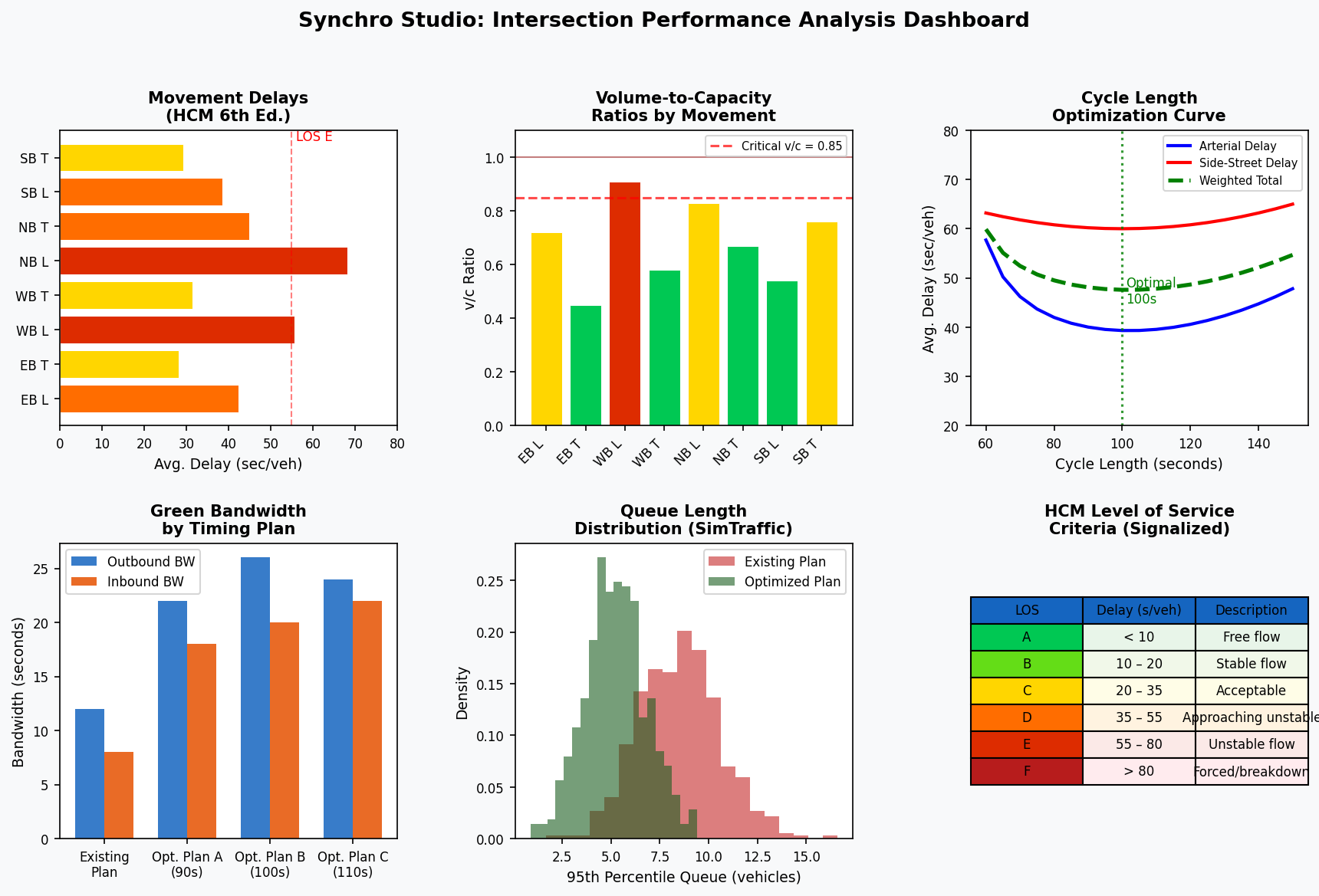
At its foundation, Synchro implements the HCM 6th Edition (and earlier editions) computational procedures for signalized intersections, roundabouts, and unsignalized stop-controlled approaches. The software calculates level of service (LOS), delay, queue lengths, and volume-to-capacity (v/c) ratios for each movement at each intersection—providing the quantitative performance metrics that agencies require for project justification and regulatory compliance.
The proprietary SYNCHRO optimization engine distinguishes the tool from manual HCM spreadsheet calculations. Given a network of signalized intersections, the engine simultaneously optimizes:

- Cycle length across the corridor or network (typically 60–150 seconds)
- Phase splits (green time allocation per phase)
- Offsets (the timing relationship between adjacent signals to create coordinated green bands)
The optimization objective can be configured to minimize total delay, minimize stops, maximize bandwidth (the width of the green band in a time-space diagram), or balance these objectives using weighted criteria. For arterial corridors with dominant directional flow—morning inbound, evening outbound—bandwidth maximization is often the preferred objective, as it minimizes the number of stops experienced by platoons traveling at the design speed.
Time-Space Diagrams and Bandwidth Analysis
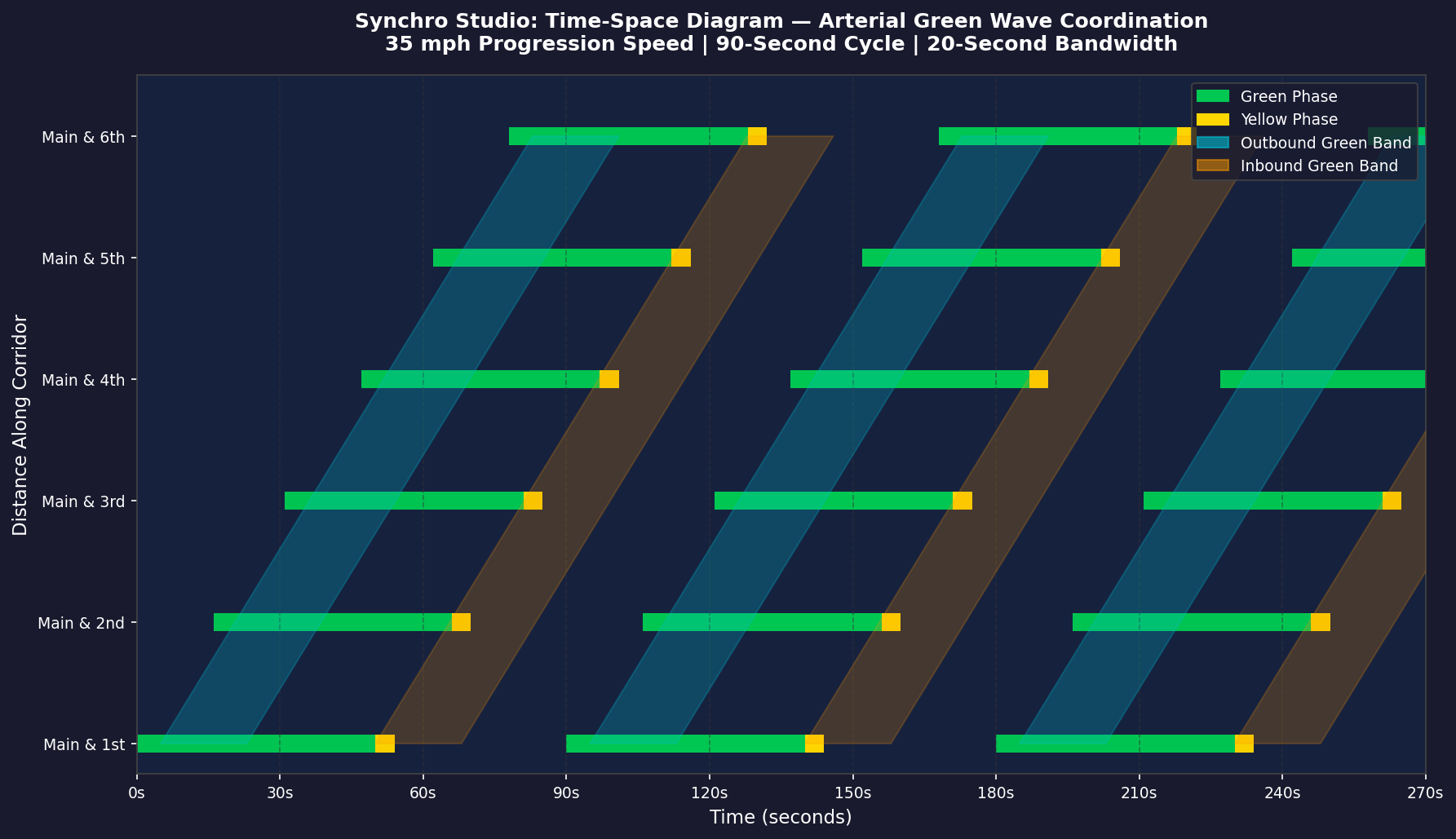
One of Synchro's most powerful visualization tools is the time-space diagram, which plots signal phase states (green, yellow, red) against distance along a corridor over time. The resulting "green band" graphically represents the window of time during which a vehicle traveling at the progression speed will encounter green lights at successive intersections without stopping.
Synchro's bandwidth analysis quantifies:
- Bandwidth efficiency: the ratio of green band width to cycle length, expressed as a percentage
- Progression quality: a composite metric incorporating bandwidth, number of stops, and delay
- Platoon dispersion: how vehicle platoons spread out between intersections due to speed variation
Engineers use these metrics to evaluate competing timing plan alternatives and to communicate the benefits of coordination to non-technical stakeholders. A well-coordinated arterial can reduce average stops by 30–50% compared to isolated operation, with corresponding reductions in fuel consumption and emissions.
SimTraffic Integration: Microscopic Validation
Synchro Studio is bundled with SimTraffic, a microscopic traffic simulation module that uses the intersection geometry and timing plans defined in Synchro as direct inputs. This tight integration enables a two-stage workflow that is central to professional practice:
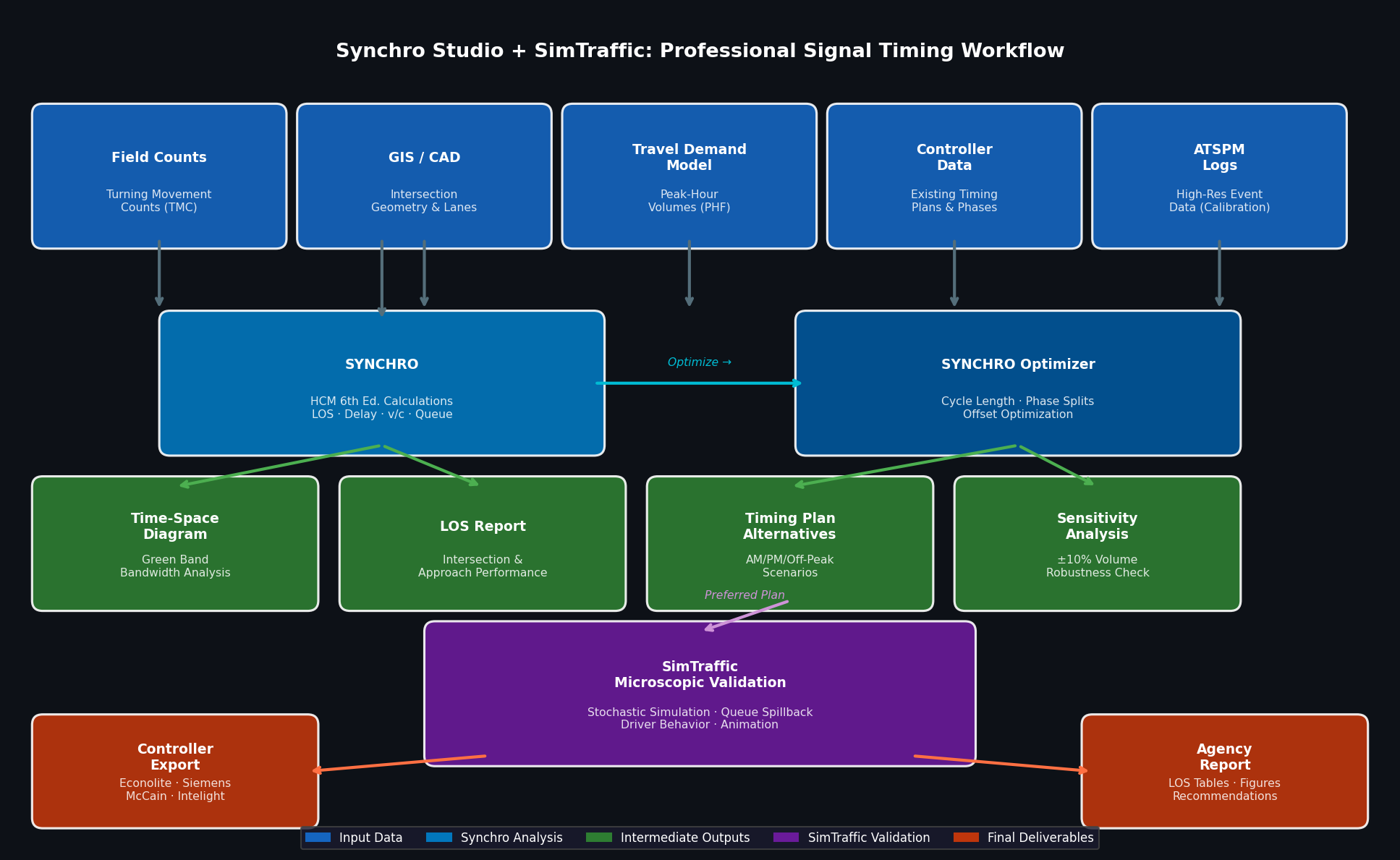
- Synchro (macroscopic): Rapidly evaluate dozens of timing plan alternatives using HCM-based calculations. Identify the optimal cycle length, splits, and offsets.
- SimTraffic (microscopic): Validate the selected plan by simulating individual vehicle behavior, including lane-changing, gap acceptance, and queue spillback interactions that HCM methods cannot capture.
SimTraffic's stochastic simulation accounts for driver behavior variability and produces animated visualizations that are effective for public meetings and agency presentations. The workflow avoids the time-consuming network coding required by standalone microscopic simulators like VISSIM, since the Synchro network geometry transfers directly.
Practical Workflow: From Field Data to Timing Plan
A typical Synchro project follows this sequence:
- Network coding: Import intersection geometry from GIS shapefiles or CAD drawings, or code manually. Define lane configurations, turn movement counts (TMCs), and posted speeds.
- Volume entry: Input peak-hour turning movement counts, typically from field counts or travel demand model outputs. Apply peak-hour factors (PHF) to convert hourly volumes to peak 15-minute flow rates.
- Existing conditions analysis: Run HCM calculations to establish baseline LOS and identify deficient movements (v/c > 0.85 or LOS E/F).
- Optimization: Run the SYNCHRO optimizer for the target scenario (AM peak, PM peak, off-peak). Review the time-space diagram and bandwidth metrics.
- Sensitivity analysis: Test ±10% volume variations to assess plan robustness. Evaluate alternative cycle lengths (e.g., 90s vs. 110s) for tradeoffs between arterial progression and side-street delay.
- SimTraffic validation: Run 10–15 simulation seeds for the preferred plan. Compare average delay and queue lengths against HCM results; investigate discrepancies caused by spillback or unusual geometry.
- Plan export: Generate signal timing sheets in formats compatible with major controller vendors (Econolite, Siemens, McCain, Intelight) for field implementation.
Advanced Features: Actuated Control and Connected Vehicle Extensions
Modern Synchro versions support actuated coordinated signal control modeling, where phases can extend or gap-out based on detector actuation within a coordinated cycle. This is critical for arterials where side-street volumes vary significantly—fixed splits would either over-serve low-volume phases or under-serve high-volume phases.
Synchro also includes tools for ATSPM (Automated Traffic Signal Performance Measures) data import, allowing engineers to calibrate models against high-resolution controller event logs. This closes the loop between design and operations: field performance data validates the model, and the model guides re-optimization when performance degrades.
For agencies exploring connected and automated vehicle (CAV) impacts, Synchro's volume adjustment capabilities allow engineers to test scenarios where a percentage of vehicles receive Signal Phase and Timing (SPaT) broadcasts and adjust their approach speeds accordingly—a simplified but useful first-order assessment of CAV benefits on arterial operations.
Limitations and Complementary Tools
Synchro's HCM-based approach has well-documented limitations. The methodology assumes uniform arrival patterns and does not explicitly model queue spillback between intersections—a significant gap for oversaturated networks. For congested urban grids where spillback is pervasive, microscopic tools (VISSIM, AIMSUN) or mesoscopic dynamic traffic assignment platforms (AIMSUN Next, TransModeler) provide more accurate results.
Synchro also lacks native support for freeway weaving, interchange ramp metering, and multi-modal transit signal priority (TSP) optimization beyond basic phase extension. For TSP design, specialized tools like VISSIM with the TSP extension or Rhythm Engineering's InSync platform are better suited.
Despite these constraints, Synchro remains indispensable for the arterial signal timing workflow. Its speed, HCM compliance, and direct controller export capability make it the practical choice for the majority of signal timing projects that do not require full microscopic fidelity.
Further Resources
- Trafficware Synchro Studio Product Page — Official documentation, training resources, and version release notes
- HCM 6th Edition, Chapter 19 — Signalized Intersections methodology underlying Synchro's calculations
- FHWA Traffic Signal Timing Manual — Comprehensive reference for signal timing practice, with Synchro workflow examples
- Institute of Transportation Engineers (ITE) — Professional organization with Synchro training courses and technical resources
- ATSPM Program (FHWA) — Automated Traffic Signal Performance Measures program for data-driven signal operations