

MONICA: Simulating Soil-Crop Carbon and Nitrogen Dynamics for Precision Nutrient Management
Overview
MONICA (Model for Nitrogen and Carbon in Agroecosystems) is an open-source, process-based soil-crop simulation model developed by the Leibniz Centre for Agricultural Landscape Research (ZALF) in Germany. Unlike single-nutrient or empirical crop models, MONICA couples detailed soil organic matter (SOM) decomposition, nitrogen (N) and carbon (C) cycling, water balance, and crop growth into a unified daily time-step framework. This tight integration makes it particularly valuable for evaluating long-term soil fertility trajectories, greenhouse gas (GHG) mitigation strategies, and site-specific fertilizer recommendations under current and future climate scenarios.
This article focuses on MONICA's soil organic matter and nitrogen cycling modules — the engine behind its reputation for precision nutrient management — and provides practical guidance for configuring and interpreting simulations.
Core Architecture
MONICA's simulation stack consists of four tightly coupled sub-models:

-
Soil Water Balance — Richards-equation-based water flow through a multi-layer soil profile (up to 20 layers, configurable depth increments). Evapotranspiration is computed via the Penman-Monteith approach, and macropore bypass flow can be activated for structured soils.
-
Soil Temperature — A heat-conduction model propagates surface temperature into the profile, which in turn controls microbial activity rates and frost effects on nitrogen transformations.
-
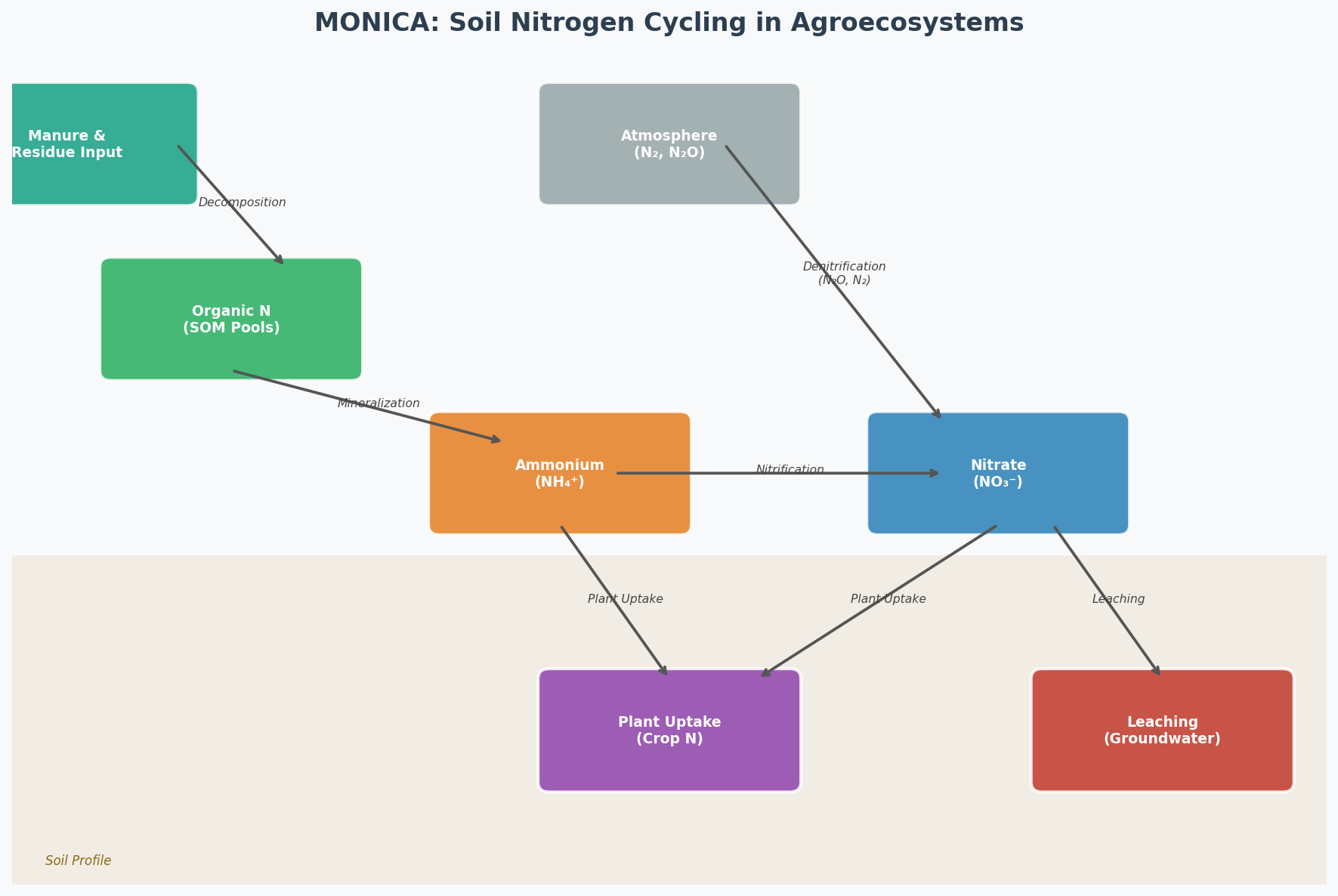
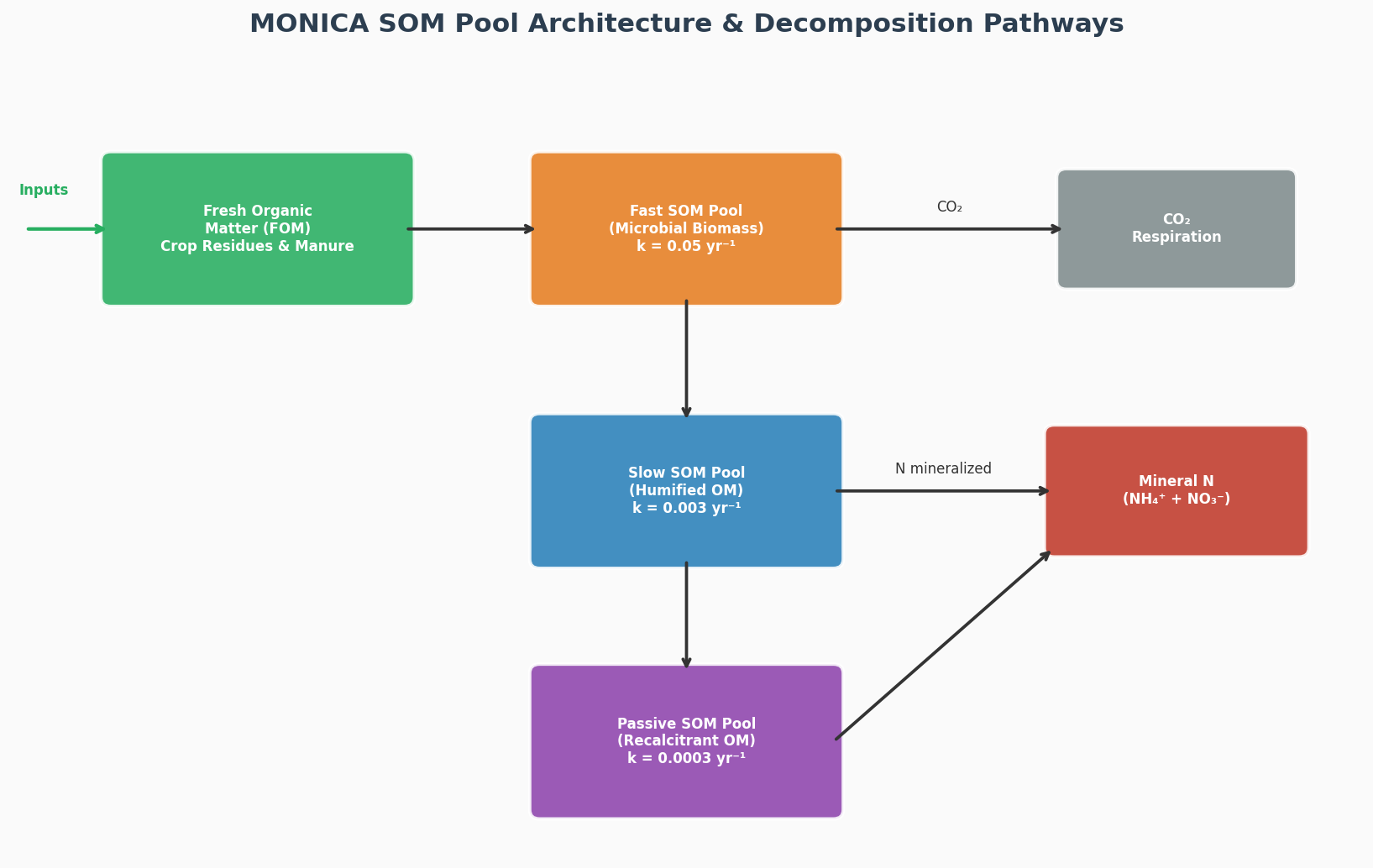
Soil Organic Matter & Nitrogen Cycling — Based on the RothC and DAISY frameworks, MONICA tracks three SOM pools (fast, slow, passive) plus fresh organic matter (FOM) from crop residues and manure. Mineralization, nitrification, denitrification, and ammonia volatilization are all simulated as temperature- and moisture-dependent first-order processes.
-
Crop Growth — A SUCROS-derived radiation-use-efficiency model drives biomass accumulation, partitioned to leaves, stems, roots, and storage organs. Phenological development is governed by thermal time with optional vernalization and photoperiod corrections.
The Nitrogen Cycling Module in Detail
The nitrogen module is MONICA's most distinctive capability. Key processes include:
Mineralization and Immobilization
Net N mineralization from SOM pools is computed as:
N_min = k_pool × C_pool × (C:N_pool)^-1 × f(T) × f(θ)where k_pool is the pool-specific decomposition rate constant, f(T) is a Q₁₀-based temperature response function (Q₁₀ ≈ 2.0), and f(θ) is a soil moisture scalar that peaks at field capacity and declines under both drought and waterlogging. Immobilization occurs when the C:N ratio of decomposing material exceeds ~25, temporarily locking mineral N into microbial biomass.
Nitrification and Denitrification
Ammonium (NH₄⁺) nitrification to nitrate (NO₃⁻) follows Michaelis-Menten kinetics, with inhibition at low pH (<5.5) and high temperatures (>35 °C). Denitrification is modeled as a function of NO₃⁻ concentration, water-filled pore space (WFPS > 60%), and labile carbon availability — critical for estimating N₂O emissions from poorly drained soils.
Fertilizer and Manure Inputs
MONICA supports mineral fertilizers (urea, ammonium nitrate, calcium ammonium nitrate), slurries, and solid manures. Each organic amendment is characterized by its FOM pool fractions (carbohydrates, cellulose, lignin), enabling realistic decomposition trajectories. Urea hydrolysis and ammonia volatilization from surface-applied materials are explicitly simulated, which is essential for comparing application methods (injection vs. broadcast).
Practical Workflow: Long-Term Soil Carbon Scenario Analysis
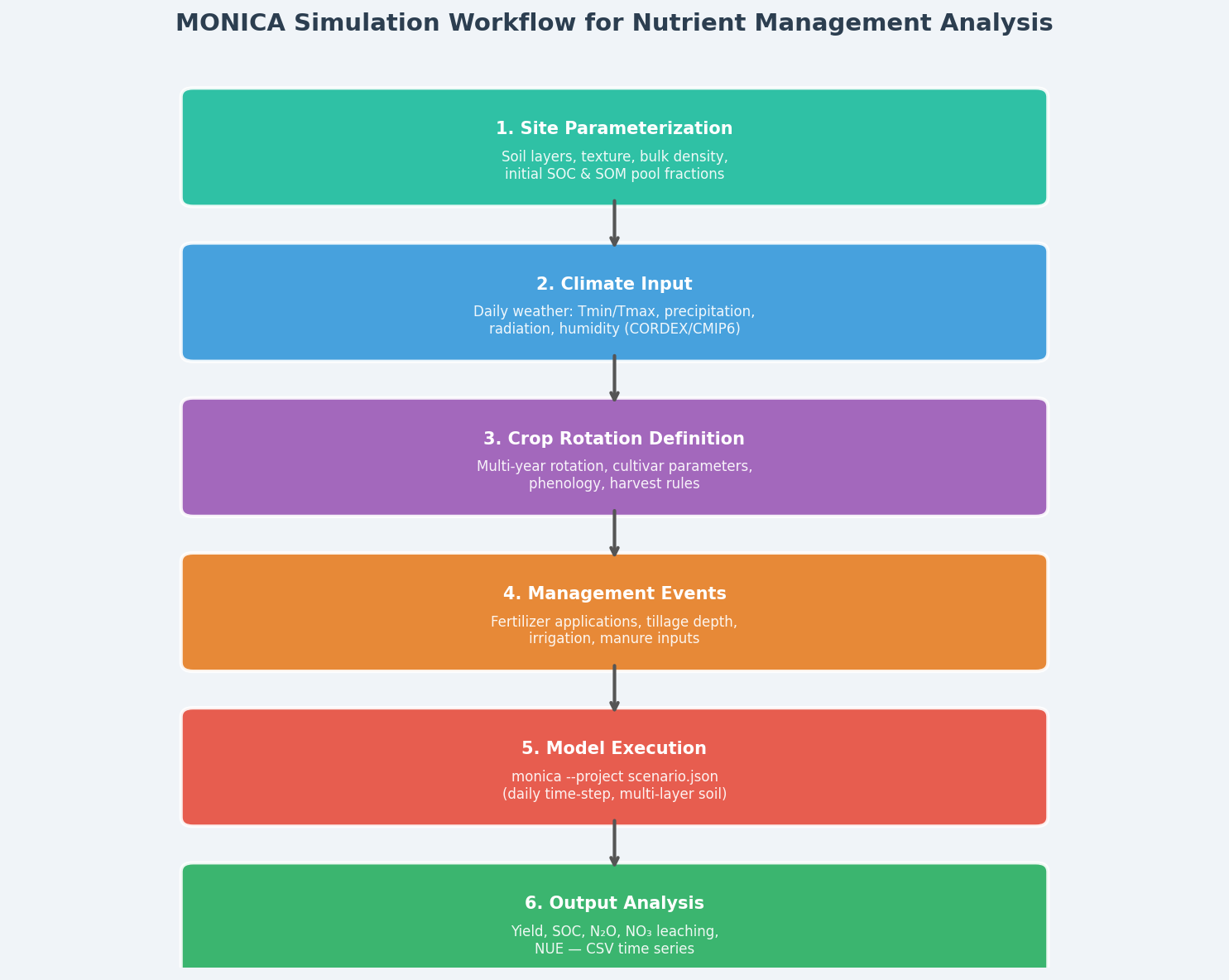
A typical MONICA workflow for evaluating cover crop impacts on soil organic carbon (SOC) proceeds as follows:
1. Site Parameterization
Prepare a JSON-format site file specifying:
- Soil texture, bulk density, and organic carbon content per layer
- Initial SOM pool partitioning (use the built-in equilibrium spin-up tool for steady-state initialization)
- Latitude, elevation, and groundwater depth
2. Climate Input
MONICA accepts daily weather files (CSV or JSON) with minimum/maximum temperature, precipitation, solar radiation, and relative humidity. For climate change scenarios, bias-corrected CORDEX or CMIP6 projections can be substituted directly.
3. Crop Rotation Definition
Define a multi-year rotation (e.g., winter wheat → oilseed rape → cover crop → maize) in a JSON crop rotation file. Each crop entry specifies sowing date, cultivar parameters, and harvest rules.
4. Fertilization and Management Events
Management events — tillage, fertilizer applications, irrigation — are specified as dated event lists. MONICA supports minimum-tillage and no-till scenarios by adjusting SOM mixing depths and residue incorporation fractions.
5. Running Simulations
MONICA is invoked from the command line or via its Python API (monica-python):
monica --project my_scenario.json --output results/Output files include daily and annual time series for crop yield, soil mineral N, SOC stocks, N₂O emissions, and nitrate leaching — all in CSV format for straightforward post-processing.
Interpreting Key Outputs
| Output Variable | Typical Use Case |
|---|---|
SoilOrganicC (t C ha⁻¹) |
Long-term SOC trend under rotation/tillage scenarios |
NO3Leaching (kg N ha⁻¹ yr⁻¹) |
Nitrate pollution risk assessment, NVZ compliance |
N2OEmissions (kg N₂O-N ha⁻¹) |
GHG inventory, carbon footprint calculations |
CropYield (t DM ha⁻¹) |
Yield gap analysis, fertilizer optimization |
NUptake (kg N ha⁻¹) |
Nitrogen use efficiency (NUE) benchmarking |
A common finding in MONICA scenario studies is that cover crops increase SOC by 0.05–0.15 t C ha⁻¹ yr⁻¹ while reducing autumn nitrate leaching by 20–40%, depending on species and termination timing — results that align well with field meta-analyses.
Integration with Precision Agriculture Platforms
MONICA's JSON-based I/O and Python API make it straightforward to embed within larger decision-support pipelines:
- Spatial scaling: Couple MONICA with GIS layers (soil maps, yield monitor data) to run field-by-field simulations across a farm or region using the
monica-runbatch runner. - Optimization loops: Use Python's
scipy.optimizeorpymooto minimize N₂O emissions subject to yield constraints by varying fertilizer timing and rate. - Digital twin integration: MONICA has been integrated into the FIWARE-based SmartAgriFood platform for near-real-time soil N status monitoring.
Strengths and Limitations
Strengths:
- Rigorous, peer-reviewed SOM and N cycling based on established frameworks (RothC, DAISY)
- Full open-source (MIT license) with active GitHub community
- Validated across >50 European and global long-term field experiments
- Native support for GHG emission outputs (N₂O, CO₂)
Limitations:
- Parameterization of SOM pool fractions requires either laboratory fractionation data or spin-up assumptions
- Phosphorus cycling is not currently modeled (planned for future releases)
- Spatial coupling requires external scripting; no built-in GIS interface
Getting Started
- Source code & documentation: https://github.com/zalf-rpm/monica
- Python bindings:
pip install monica-python - Example datasets: Available in the
monica-datarepository with calibrated parameterizations for wheat, maize, and oilseed rape across European soil types - Community forum: https://github.com/zalf-rpm/monica/discussions
- Key validation paper: Nendel et al. (2011), Ecological Modelling, 222(9): 1614–1625. https://doi.org/10.1016/j.ecolmodel.2011.02.018
Conclusion
MONICA occupies a valuable niche among agricultural simulation tools: it provides the mechanistic rigor needed for credible long-term soil carbon and nitrogen assessments without the complexity overhead of full Earth-system models. For agronomists, environmental consultants, and precision agriculture researchers who need defensible estimates of nitrate leaching, N₂O emissions, and SOC trajectories under alternative management scenarios, MONICA's open-source architecture and well-validated process library make it a compelling choice. Its JSON-native design and Python API lower the barrier to integration with modern data pipelines, positioning it well for the next generation of farm-scale digital decision support.