

OpenFarm: Agent-Based Simulation of Smallholder Farming Systems for Food Security Analysis
Introduction
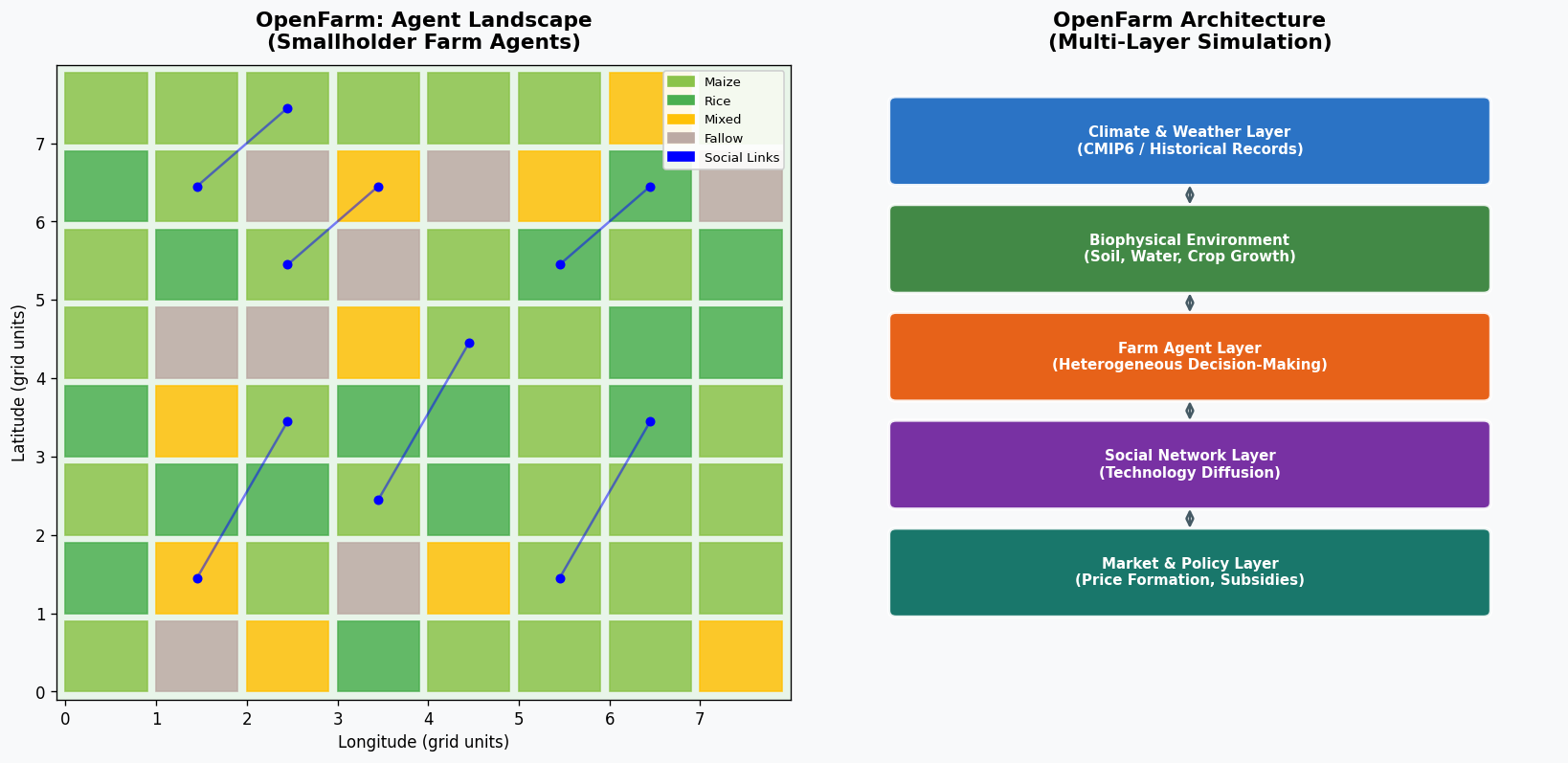
Smallholder farms — typically defined as operations under 2 hectares — account for roughly 70% of global food production in developing regions, yet they remain among the most vulnerable to climate variability, market shocks, and resource constraints. Modeling these systems requires tools that capture heterogeneous decision-making, social networks, and adaptive behavior that traditional crop models cannot represent. OpenFarm is an open-source, agent-based simulation framework purpose-built for smallholder farming systems, enabling researchers and policy analysts to explore how individual farm-level decisions aggregate into regional food security outcomes.
This article examines OpenFarm's core architecture, its key modeling capabilities, and practical guidance for applying it to food security scenario analysis.
What Is OpenFarm?
OpenFarm is built on the NetLogo and Mesa (Python) platforms, providing two runtime environments depending on the user's preference for visual exploration or large-scale batch computation. Each simulated "agent" represents an individual farm household with attributes including:

- Land area and soil quality (parameterized from FAO GAEZ datasets)
- Household size and labor availability
- Access to credit, inputs, and markets
- Risk tolerance and adaptive decision rules
Agents interact with a shared environment layer representing rainfall, temperature, and commodity prices, which can be driven by historical records or climate projection ensembles (e.g., CMIP6 scenarios).
Core Modeling Capabilities
1. Heterogeneous Decision-Making
Unlike process-based crop models that assume a single "representative farmer," OpenFarm assigns each agent a distinct decision profile. Farmers choose crop portfolios, input levels, and selling strategies based on bounded-rationality rules calibrated from household survey data (e.g., LSMS-ISA datasets from the World Bank). This allows the model to reproduce observed income inequality and differential adoption rates for improved seed varieties or irrigation technology.
2. Social Network Effects and Technology Diffusion
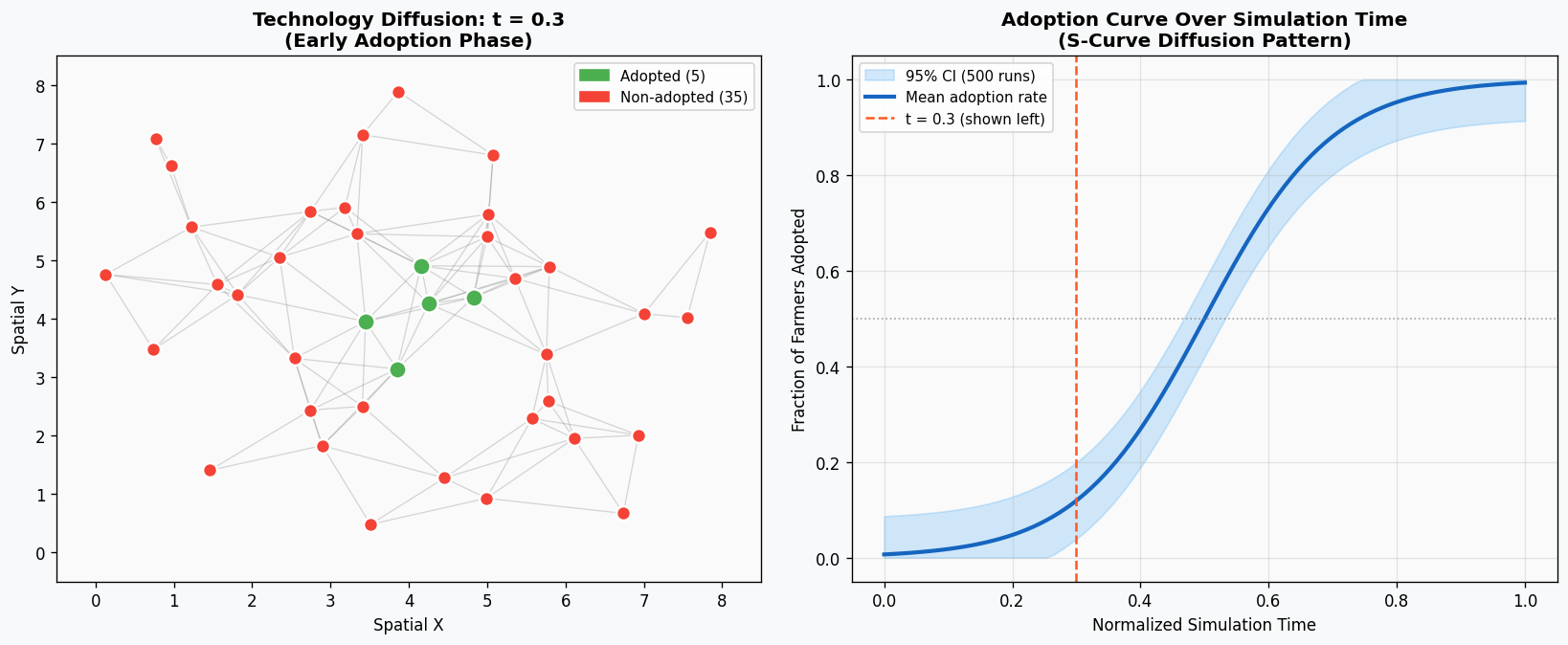
OpenFarm includes a configurable social network layer where agents exchange information about new practices. The diffusion of drought-tolerant maize varieties, for example, follows a threshold-based contagion model: a farmer adopts a new technology when a sufficient fraction of their network neighbors have already adopted it. Researchers can test how extension service targeting (e.g., seeding adoption among high-centrality nodes) accelerates or slows diffusion across the landscape.
3. Market and Price Dynamics
A built-in market module simulates local commodity price formation as a function of aggregate supply from all farm agents and an exogenous demand curve. This endogenous price feedback is critical for evaluating policy interventions: a subsidy that boosts production across thousands of farms may depress local prices, partially offsetting income gains — a dynamic that static crop models miss entirely.
4. Shock and Stress Testing
OpenFarm supports stochastic shock injection at any simulation step:
- Drought events — reduce soil moisture below crop stress thresholds for configurable durations
- Pest and disease outbreaks — apply yield penalties to spatially clustered agents
- Market disruptions — spike input costs or collapse output prices to simulate supply chain failures
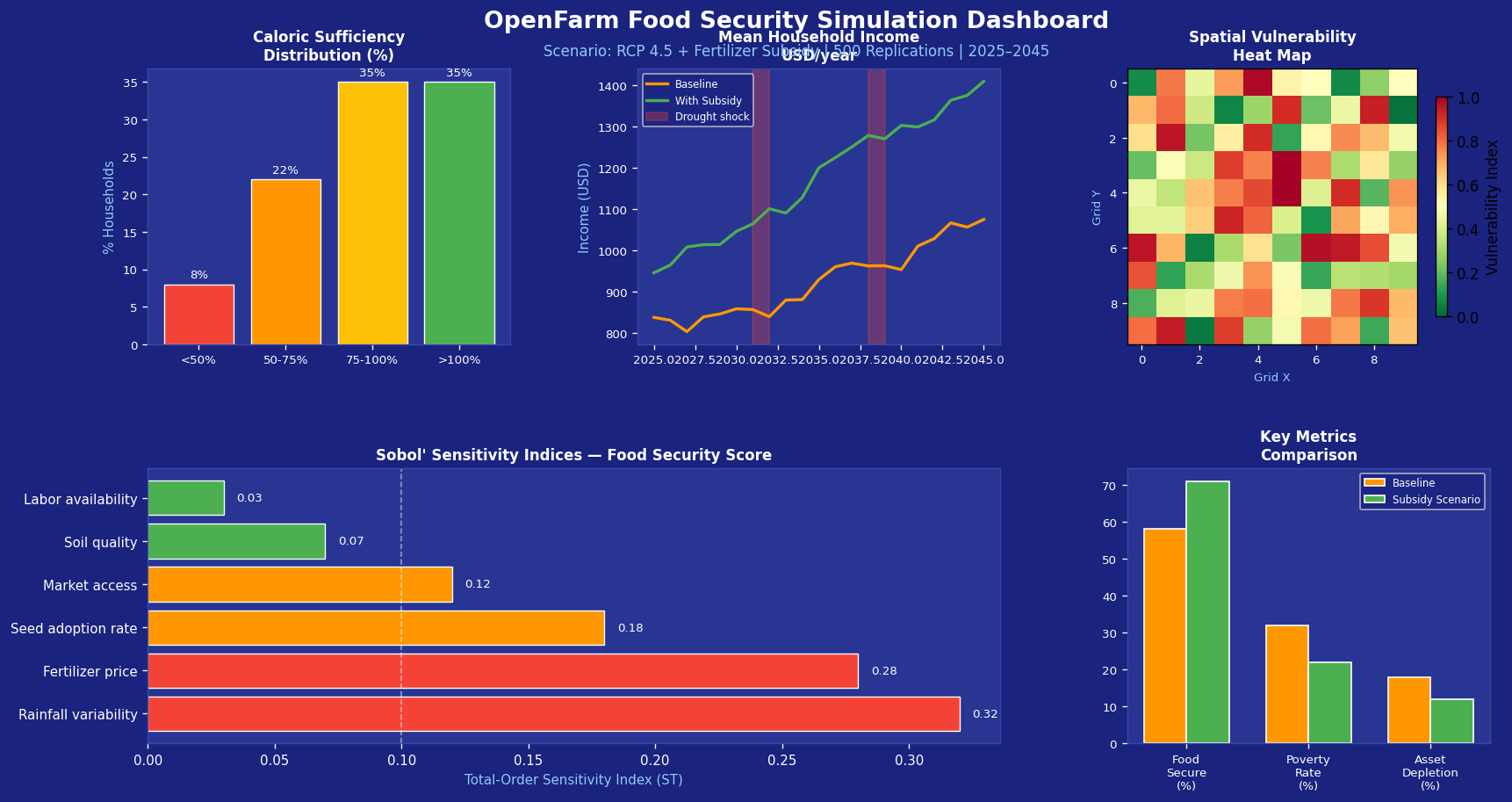
Ensemble runs (typically 500–1,000 replications) generate probability distributions over food security indicators such as household caloric sufficiency, income below the poverty line, and asset depletion rates.
Workflow: Setting Up a Food Security Scenario
A typical OpenFarm analysis follows five stages:
- Parameterization — Import household survey data and GIS layers (soil, rainfall, road networks) to initialize agent attributes and the spatial environment.
- Calibration — Run the model against a historical baseline period (e.g., 2000–2020) and adjust behavioral parameters until simulated crop yields and income distributions match observed statistics.
- Scenario Definition — Define intervention or stress scenarios (e.g., a 20% rainfall reduction under RCP 4.5, combined with a fertilizer subsidy program).
- Ensemble Execution — Use OpenFarm's batch runner to execute hundreds of stochastic replications in parallel, leveraging Python's
multiprocessingmodule or HPC job schedulers. - Post-Processing — Aggregate outputs using the built-in
openfarm.analysismodule to compute food security metrics, generate spatial heat maps of vulnerability, and produce sensitivity indices via SALib integration.
Practical Considerations and Limitations
Data requirements are the primary challenge. Reliable household survey data with sufficient sample sizes is essential for meaningful calibration; in data-sparse regions, synthetic populations generated from national census microdata can serve as a fallback, though with reduced confidence.
Computational cost scales with the number of agents and simulation length. A 10,000-agent, 20-year simulation with 500 replications typically requires 4–8 hours on a 16-core workstation. Cloud deployment on AWS Batch or Google Cloud Run can reduce wall-clock time to under 30 minutes.
Model validation should include both pattern-oriented validation (does the model reproduce observed distributional patterns?) and predictive validation against held-out years. OpenFarm's documentation recommends a minimum 5-year hold-out period for climate scenario applications.
Integration with Other Tools
OpenFarm is designed to interoperate with the broader agricultural modeling ecosystem:
- DSSAT / APSIM — Crop growth sub-models from these platforms can replace OpenFarm's simplified yield functions for higher biophysical fidelity.
- SWAT+ — Watershed hydrology outputs (soil moisture, runoff) can drive OpenFarm's rainfall-stress module at sub-field resolution.
- AnyLogic — For supply chain extensions, OpenFarm agent outputs can be exported as demand signals into AnyLogic cold chain logistics models.
Further Resources
- OpenFarm GitHub Repository — Source code, documentation, and example models
- FAO GAEZ Data Portal — Agro-ecological zone data for agent initialization
- World Bank LSMS-ISA — Household survey datasets for calibration
- SALib Sensitivity Analysis Library — Global sensitivity analysis for OpenFarm ensemble outputs
- NetLogo Models Library — Reference agent-based models for agricultural systems
Conclusion
OpenFarm fills a critical gap in the agricultural simulation toolkit by placing heterogeneous human decision-making at the center of food security analysis. Its ability to model technology diffusion, endogenous market dynamics, and stochastic shocks makes it particularly valuable for evaluating policy interventions in smallholder-dominated agricultural systems. When combined with process-based crop models and watershed hydrology tools, OpenFarm enables a multi-scale, multi-method approach that captures both the biophysical and socioeconomic drivers of food security outcomes.