

TELEMAC-2D: Depth-Averaged Hydrodynamic Simulation for Coastal and Riverine Flood Modeling
TELEMAC-2D is a depth-averaged, finite-element hydrodynamic solver developed by the TELEMAC-MASCARET consortium—a collaboration led by EDF R&D (France) and supported by HR Wallingford, BAW, and other European research institutions. It solves the shallow-water (Saint-Venant) equations on unstructured triangular meshes, making it one of the most capable open-source tools for simulating free-surface flows in rivers, estuaries, and coastal zones. This article examines TELEMAC-2D's core capabilities, mesh strategy, turbulence closure options, and best practices for coastal flood modeling.
Why TELEMAC-2D for Environmental Simulation?
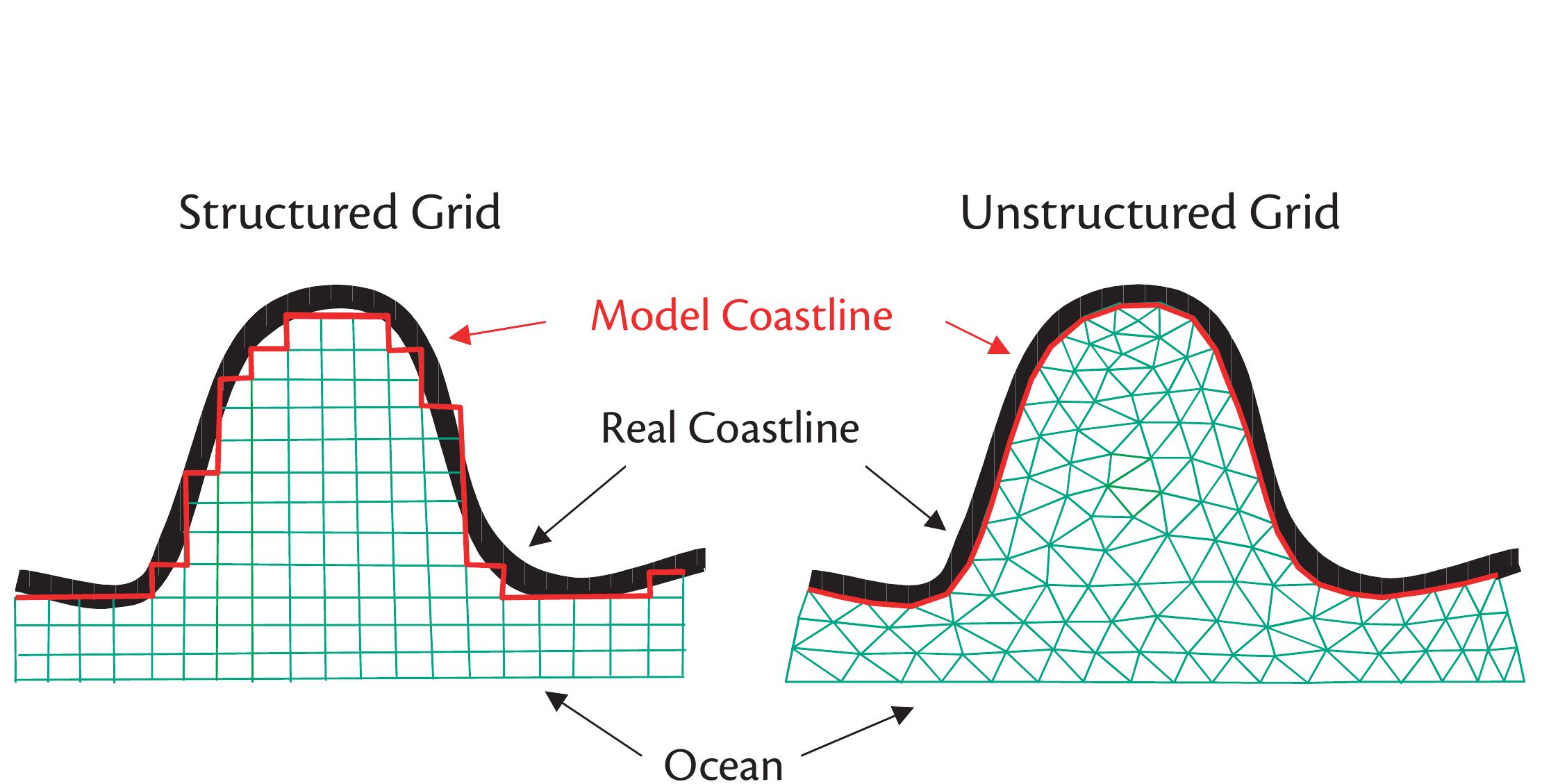
Unlike structured-grid solvers, TELEMAC-2D's unstructured mesh adapts resolution to the complexity of the domain: fine triangles resolve narrow channels, levee crests, and urban street networks, while coarser elements cover open water bodies. This flexibility reduces cell count by 30–60% compared to equivalent structured grids, directly cutting compute time without sacrificing accuracy in critical zones.
The solver is fully parallelized via MPI and scales efficiently to hundreds of CPU cores. It is freely available under the GPL v3 license and integrates with the broader TELEMAC-MASCARET suite, including TOMAWAC (spectral wave propagation) and SISYPHE (sediment transport), enabling tightly coupled wave–current–sediment simulations.

Governing Equations and Numerical Scheme
TELEMAC-2D solves the 2D shallow-water equations:
- Continuity: ∂h/∂t + ∂(hu)/∂x + ∂(hv)/∂y = 0
- Momentum (x): ∂(hu)/∂t + ∂(hu²)/∂x + ∂(huv)/∂y = −gh(∂Z/∂x) + τ_x/ρ + ν_t ∇²(hu)
- Momentum (y): analogous in y-direction
where h is water depth, u and v are depth-averaged velocity components, Z is the free-surface elevation, g is gravitational acceleration, τ represents bed friction, and ν_t is the eddy viscosity.
The default discretization uses a characteristic Galerkin scheme with explicit time-stepping, offering second-order accuracy in space and time. For wetting/drying fronts—critical in flood inundation—TELEMAC-2D employs a mass-conservative treatment that prevents negative depths while maintaining continuity across the moving shoreline.
Mesh Generation with BlueKenue and QGIS
Mesh quality is the single most important factor in TELEMAC-2D accuracy. The recommended workflow is:
- Terrain data ingestion: Import LiDAR-derived DEMs (typically 1–2 m resolution) or bathymetric surveys. BlueKenue (NRC Canada) or QGIS with the Crayfish plugin are the standard pre-processors.
- Constraint lines: Define breaklines along levees, roads, and channel banks to prevent the mesh from averaging across sharp elevation discontinuities.
- Mesh size functions: Assign target element sizes using polygonal regions—e.g., 5 m in urban floodplains, 50 m in open estuaries, 200 m offshore.
- Quality checks: Target a minimum interior angle > 20° and a maximum aspect ratio < 5:1. Poor-quality elements degrade the CFL condition and introduce numerical diffusion.
A well-constructed mesh for a 500 km² coastal catchment typically contains 200,000–800,000 nodes, running in 2–6 hours on 32 MPI ranks for a 48-hour storm surge event.
Turbulence Closure and Bed Friction
TELEMAC-2D offers three turbulence models:
| Model | Use Case | Cost |
|---|---|---|
| Constant viscosity | Simple river reaches, calibration runs | Minimal |
| Elder model | Depth-varying dispersion in rivers | Low |
| k-ε model | Complex recirculation zones, estuaries | Moderate |
For most coastal flood studies, the Elder model with a longitudinal dispersion coefficient of 6–10 m²/s provides a good balance of accuracy and speed. The k-ε model is recommended when resolving wake structures behind coastal structures or tidal inlets.
Bed friction is specified via Manning's n or Nikuradse roughness k_s. Spatially variable friction maps—derived from land-use classifications (e.g., Corine Land Cover or NLCD)—are essential for accurate flood extent prediction. Typical values range from n = 0.025 for smooth channels to n = 0.10 for dense urban areas.
Boundary Conditions for Storm Surge Modeling
Coastal flood simulations require careful boundary condition setup:
- Offshore liquid boundary: Prescribe tidal water levels from a global tide model (e.g., FES2014, TPXO9) plus storm surge from a regional barotropic model (e.g., ADCIRC, SCHISM). TELEMAC-2D accepts time-series files in its native
.cli/.liqformat. - River inflows: Specify upstream discharge hydrographs from gauged records or rainfall-runoff models (e.g., HEC-HMS, SWAT+).
- Wind stress: Import gridded wind fields (e.g., from WRF or ERA5 reanalysis) via the METEO module to drive wind-induced setup and surge.
- Wave radiation stress: Couple with TOMAWAC to account for wave-driven setup in the surf zone—critical for open-coast scenarios.
Validation and Uncertainty Quantification
Standard validation metrics for TELEMAC-2D flood models include:
- Flood extent: F-score (Critical Success Index) against satellite-derived inundation maps (Sentinel-1 SAR, Copernicus EMS)
- Water levels: RMSE and bias against tide gauge records and high-water marks
- Velocity: Comparison with ADCP transects in rivers and estuaries
A well-calibrated model typically achieves F-scores > 0.75 for flood extent and RMSE < 0.15 m for water levels. Sensitivity analysis on Manning's n (±20%) and mesh resolution is recommended before operational deployment.
For uncertainty quantification, TELEMAC-2D integrates with OpenTURNS and the TELEMAC-MASCARET UQ framework, enabling Monte Carlo and polynomial chaos expansion analyses over uncertain input parameters.
Practical Tips for Operational Flood Forecasting
- Hotstart files: Save model state at the end of a spin-up run and restart from it for ensemble forecasts, eliminating repeated initialization overhead.
- Parallel I/O: Use the MED (HDF5-based) output format instead of SELAFIN for large meshes; it supports parallel writes and is directly readable by ParaView.
- Adaptive time-stepping: Enable the Courant-number-based adaptive Δt (keyword
VARIABLE TIME-STEP = YES) to automatically handle rapidly changing flow conditions during surge onset. - GPU acceleration: TELEMAC-2D v8.5+ includes experimental CUDA support for GPU-accelerated matrix assembly, offering 3–5× speedup on NVIDIA A100 hardware.
Further Resources
- TELEMAC-MASCARET Official Documentation
- OpenTELEMAC Community Forum
- BlueKenue Pre-processor (NRC Canada)
- Copernicus Emergency Management Service (validation data)
- FES2014 Global Tide Model
TELEMAC-2D's combination of unstructured mesh flexibility, open-source licensing, and tight integration with wave and sediment modules makes it a premier choice for coastal and riverine flood simulation. With proper mesh design, physically consistent boundary conditions, and rigorous validation, it delivers operational-grade accuracy for storm surge, tidal flooding, and compound event analysis.